










Kegs aren’t just for pubs anymore. From backyard parties to weddings and festivals, kegs are becoming the go-to way to serve drinks on tap — fresh, cold, and with far less waste. But what size keg do you actually need? How many beers (or wines, or cocktails) does a keg hold? And are kegs really better for the environment?
This guide has the answers.
Why Use Kegs?
There’s a reason kegs are loved by brewers, bartenders, and event planners alike. Compared to bottles or cans, kegs offer:
- Freshness – Drinks stay carbonated and crisp for weeks.
- Convenience – No bottle caps, cartons, or endless recycling runs.
- Cost savings – Bulk storage = better value per drink.
- Event-ready vibes – Nothing says “party” like pouring a cold one straight from the tap.
- Versatility – Not just for beer: kegs can hold cocktails, wine, mocktails, or even kombucha.
Keg Sizes Explained
Kegs come in a surprising variety of sizes, from compact mini kegs perfect for home use to full 50L barrels for big events.
Here are the most common sizes you’ll find in Australia and the USA:
- Mini Keg (5L / ~14 beers) – Handy for picnics or small get-togethers.
- Cornelius Keg (19L / ~50 beers) – Popular with homebrewers and cocktails on tap.
- 20L Keg (~55 beers) – Great for smaller events or craft beer specialty batches.
- 30L Keg (~85 beers) – Easy to transport, ideal for birthdays or casual parties.
- 50L Keg (~165 beers) – The standard size for most commercial breweries and events.
How Many Drinks Are in a Keg?
One of the most popular questions we are asked is How many Beers are in a Keg? Here’s where it gets practical: how many drinks you’ll actually get from each keg.
| Keg Size | Beer Servings (Schooner 425ml) | Beer Servings (Pint 570ml) | Wine Servings (150ml) | Cocktail Servings (285ml) | Can Servings (375ml) |
|---|---|---|---|---|---|
| 19L (Cornelius) | ~45 | ~33 | ~126 | ~67 | ~50 |
| 30L | ~70 | ~52 | ~200 | ~105 | ~80 |
| 50L (Australian Standard) | ~118 | ~88 | N/A | ~175 | ~133 |
👉 Quick tip: Always round down when planning. Kegs pour more accurately than cans, but serving size and foam can vary depending on how the beer is poured.
How to Store and Serve Kegs
Kegs need proper storage and serving to keep drinks tasting their best:
- Keep them cool – Ideally between 2–4°C.
- Use CO₂ for beer & cider – Keeps fizz fresh.
- Use Nitrogen for wine & cocktails – Creates a smoother pour.
- Shelf life – Untapped, kegs last months. Once tapped, beer stays fresh for 4–6 weeks, cocktails and wine usually 2–4 weeks.
The Benefits of Using Kegs
Beyond freshness and efficiency, kegs come with a stack of benefits:
- Perfect pours every time – With the right pressure, you’ll get that frothy bar-quality head.
- Less packaging waste – One keg = hundreds of bottles or cans avoided.
- Easy clean-up – No empty cartons stacked to the roof.
- Wide variety – Beer, cider, cocktails, soft drinks, kombucha, cold brew coffee — you name it, it can go in a keg.
Environmental Benefits of Kegs
Here’s the big one: kegs are a game-changer for sustainability.
- One keg replaces 1,500 cans/bottles over its lifespan.
- Lower transport emissions thanks to bulk storage.
- 100% reusable and recyclable stainless steel.
- Fewer single-use plastics compared to packaged drinks.
For eco-conscious hosts, kegs are one of the easiest ways to cut event waste.
A Quick Cost Comparison
Let’s compare:
- A 50L keg of beer (about 165 schooners) might cost around $450 → $2.70 per schooner.
- Buying the same amount in six-packs? Around $700+ → $4.20+ per schooner.
That’s serious savings, especially when you scale it up for weddings or festivals.
A Brief History
Kegs haven’t always been the shiny stainless-steel cylinders we know today. Their story stretches back thousands of years, and like most great inventions, they were born out of a need to keep drinks fresh and portable.
Where kegs originated
The roots of the keg trace back to the Celts in Northern Europe around 350 BC. They were among the first to master the craft of bending wooden staves and sealing them tightly with iron hoops, creating watertight barrels. Before this, drinks were typically stored in clay amphorae, which were heavy, fragile, and not ideal for transporting beer or wine. The Celtic design made barrels stronger, lighter, and far more practical for moving liquids.
The oldest known keg
The oldest surviving wooden beer barrel ever discovered dates to around 100 BC. Archaeologists unearthed examples in Trier, Germany, and in bogs across Northern Europe, showing just how widespread barrel-making had become. These ancient kegs weren’t just used for beer — they stored wine, honey mead, butter, and even salted fish.

When kegs became mainstream
By the time of the Roman Empire, wooden barrels had almost completely replaced amphorae for transporting liquids. The Romans quickly adopted the Celtic keg design because it was perfect for marching armies that needed supplies on the move. From there, the tradition of kegging beer spread across Europe and evolved with brewing itself.
From wood to stainless steel
Wooden kegs remained the standard for centuries. It wasn’t until the early 20th century that stainless-steel kegs began to appear, offering better hygiene, longer lifespan, and pressure stability. Today, modern kegs are precision-engineered to last decades and are used not just for beer but for wine, cocktails, kombucha, and more.
👉 Fun fact: A stainless-steel keg can last 30+ years in circulation, making it one of the most durable, reusable packaging systems ever invented.
FAQs About Kegs
How long does a keg last once tapped?
It depends on the beer and how it was brewed, processed, and stored. Generally:
- Beer: 4–6 weeks, though some styles (like highly hopped IPAs) are best enjoyed fresher, while pasteurised beers can last a little longer.
- Wine & Cocktails: 2–4 weeks, depending on ingredients and whether nitrogen is used for dispensing.
Do kegs have to stay refrigerated?
Generally, yes — warm kegs lose carbonation and spoil quicker. However, Kombi Kegs are fitted with instantaneous chiller systems that pour drinks icy cold, even if the keg itself isn’t refrigerated. While it’s best to keep kegs in a cool place, you won’t need to worry about finding coolroom space when you’re working with Kombi Keg.
Can I get small kegs for parties?
Absolutely. 19L, 20L and 30L kegs are perfect for smaller groups.
How much does a keg weigh?
50L keg full of beer = ~60kg. Always plan for handling safely.
What’s the best way to pick up a keg?
A full 50L keg can weigh around 60kg, so lifting it wrong can do your back in. The safest way is to:
- Lift with your legs, not your back – Keep your back straight and bend at the knees.
- Use two people for full-size 50L kegs — they’re heavy and awkward to handle.
- Roll, don’t carry – Kegs are designed to be rolled gently on their sides when possible.
- Use a trolley or keg lifter for easy moving, especially over distance.
👉 Pro tip: When you book Kombi Keg, you don’t need to stress about the heavy lifting. We deliver, set up, and get everything flowing — no sore backs, just cold drinks on tap.

Why Kombi Keg is the Smarter Choice
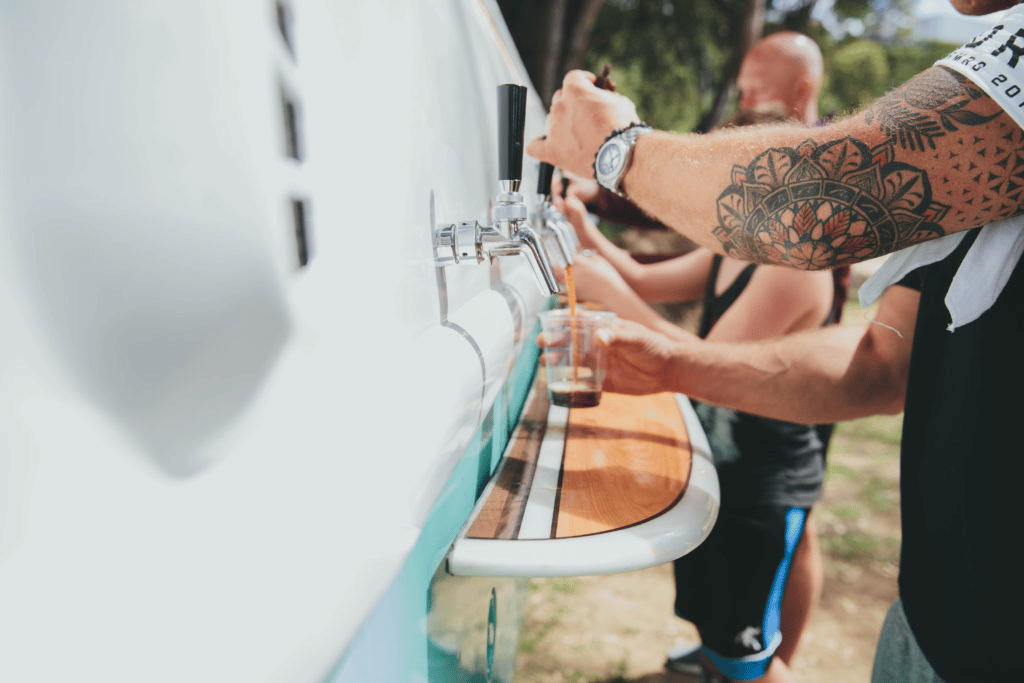
At Kombi Keg, we’ve taken the keg game to the next level with our mobile bar service on wheels. Picture a vintage Kombi van fitted with icy taps, stylish bench tops, lawn games, and even a photobooth. Whether it’s a wedding, birthday, or corporate function, we bring the kegs and the vibe.
👉 Ready to book? Lock in Kombi Keg for your next event.